





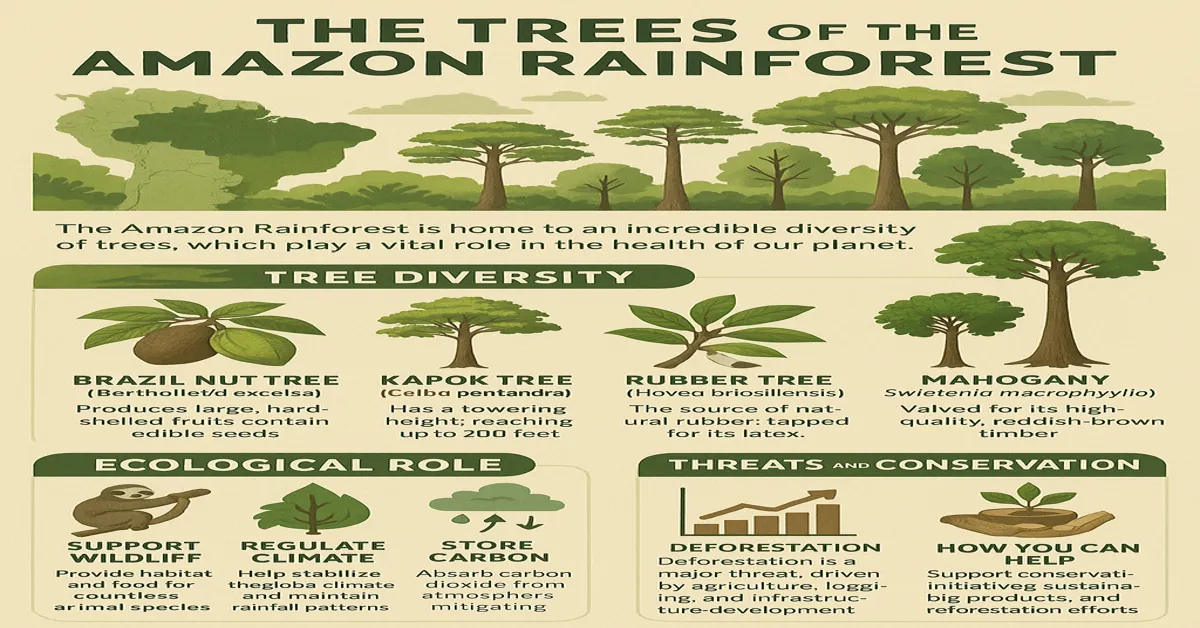

The Amazon Rainforest, often called the “lungs of the Earth,” is home to over 16,000 tree species—many of which are found nowhere else. These towering giants – like Kapok, Mahogany, Brazil Nut, and Rubber-provide critical resources, support unparalleled biodiversity, and store enormous amounts of carbon. In this post, we’ll explore their ecological importance, the threat of deforestation, and how each of us can help safeguard this vital ecosystem. Plus, don’t miss our eye-catching infographic summarizing it all!
🌱 Amazon Rainforest Tree Diversity
The Amazon is nature’s botanical treasure chest. Beyond its sheer count of species, some iconic trees stand out:
- Brazil Nut Tree (Bertholletia excelsa)
Produces nutrient-packed nuts encased in tough shells—vital for local communities, wildlife, and sustainable economies. - Kapok Tree (Ceiba pentandra)
Reaching up to 200 feet, these giants form aerial habitats that sustain birds, monkeys, and insects. - Rubber Tree (Hevea brasiliensis)
The living source of latex, once foundational to the global rubber trade and still essential today. - Mahogany (Swietenia macrophylla)
With rich reddish-brown wood, it’s famous in fine woodworking—but overharvesting has placed it on the threatened species list.
🌎 Why Amazon Trees Matter for the Planet
These forest giants are indispensable for our planet’s health:
- Support Wildlife
The Amazon supports more than 10 million known species—including jaguars, toucans, and sloths—many of which depend on tree habitats for survival. - Regulate Climate
By recycling water and releasing moisture into the atmosphere, these trees influence rain patterns both locally and globally. - Store Carbon
Acting as a massive carbon sink, the Amazon absorbs huge amounts of CO₂ each year—critical in the fight against climate change.
🪓 The Threat: Deforestation in the Amazon
Unfortunately, the Amazon is under attack:
- Around 17% of the forest has been destroyed in the past 50 years due to logging, agriculture, and infrastructure expansion.
- This destruction releases vast amounts of stored carbon and threatens countless plant and animal species with extinction.
🌿 How You Can Help Save the Rainforest
Every action counts-here’s how you can contribute:
- Choose sustainable products like shade-grown coffee, FSC-certified wood, and Brazil nuts.
- Advocate for protective policies that safeguard the rainforest and its inhabitants.
- Donate to or volunteer with organizations working directly on rainforest conservation.
- Raise awareness by sharing posts, infographics, and stories about the Amazon’s importance.
Infographic Snapshot
📊 Be sure to check out our engaging infographic showcasing:
- Key Amazon tree species
- Their ecological functions
- The scale of deforestation
- Roadmap to conservation efforts
✅ Summary Table of Resources
| Topic | Key Source & Insight |
|---|---|
| Tree Species & Habitat | Global Forest Watch: keystone trees & wildlife time.com+7Global Forest Watch+7Wikipedia+7 |
| Species Count | NCBI: ~11,000 species in Brazilian Amazon NCBI |
| Climate Regulation | Vox: Brazil Nut trees & rainfall Vox |
| Deforestation Trends | WWF, InfoAmazonia, BYU, Wikipedia WWF PandaInfoAmazoniaWikipediaBallard Brief |
| Tipping Point Risk | Guardian & Axios warnings The Guardianaxios.com |
FAQs: Amazon Rainforest Trees
The Brazil Nut, Kapok, Rubber, and Mahogany trees are among the most important due to their ecological roles, economic value, and conservation status.
Due to demand for its high-quality wood, Mahogany has been heavily logged—often illegally—leading to its population decline.
While exact numbers vary, the Amazon stores billions of tons of CO₂—conserving trees helps prevent massive greenhouse gas emissions.
Absolutely! Choosing products sustainably sourced from Amazon can reduce demand for destructive practices.
Schools can host educational events, share infographics, promote sustainable products, and engage in tree-planting initiatives or campaigns.
Traditional rubber plantations can be sustainable when integrated into natural forests, but large-scale monoculture plantations may support less biodiversity.
Conclusion
The trees of the Amazon Rainforest are more than impressive flora—they’re foundation stones supporting global biodiversity, climate stability, and human livelihoods. Though deforestation poses a serious threat, each of us holds the power to take action by choosing sustainable products, raising awareness, supporting conservation organizations, and advocating for environmental policies. Start today, and help ensure these living giants thrive for generations to come.