




Important update: As of September 3, 2026, ChatGPT Ads are officially expanding to India. OpenAI announced on August 31, 2026 that self-service advertising through Ads Manager is launching across India, Europe, the Middle East and North Africa. Fina All details for ChatGPT Ads in India
This is particularly important for D2C, e-commerce, beauty, skincare, FMCG, education, and consumer brands, because ChatGPT Ads target users already researching, comparing, and making purchase decisions.


5
1. What are ChatGPT Ads?
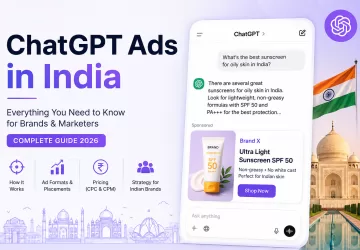
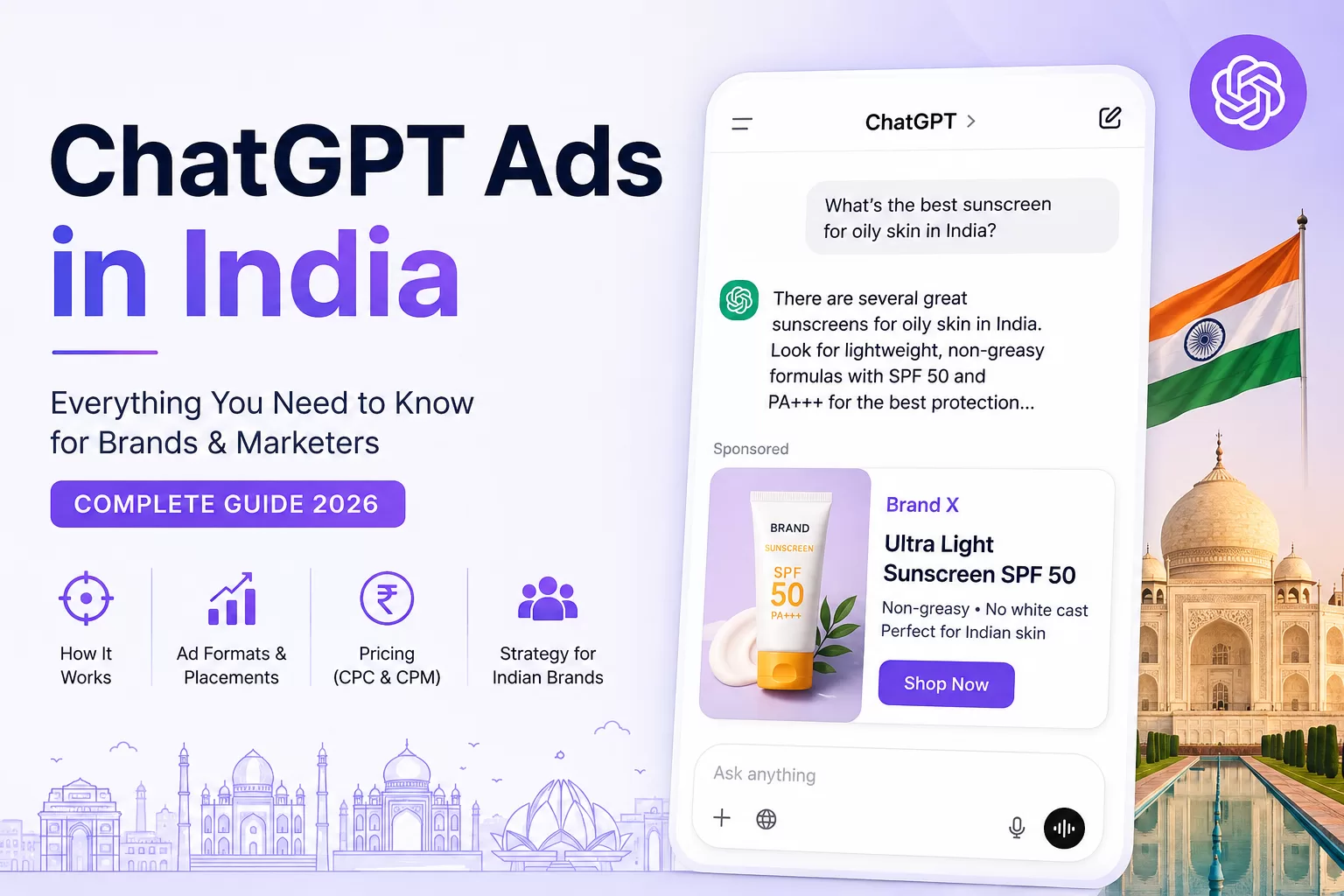
ChatGPT Ads are paid advertisements displayed below ChatGPT’s responses.
For example, imagine a user asks:
“What’s the best sunscreen for oily skin in India?”
ChatGPT answers the question independently. An advertiser could potentially have a relevant ad appear underneath the response.
The key difference from traditional Google Search Ads is that the environment is conversational and intent-based, rather than a conventional search-results page.
OpenAI says ads are clearly labeled and do not influence ChatGPT’s answers.
2. Is ChatGPT Ads available in India?
Yes. ChatGPT Ads in India
OpenAI announced on August 31, 2026 that advertisers can purchase ChatGPT Ads directly through Ads Manager across:
- 🇮🇳 India
- Europe
- Middle East
- North Africa
This follows the earlier rollout in markets including the US, UK, Mexico, Brazil, Japan and South Korea.
So India is now an official ChatGPT advertising market, rather than merely a waitlist/pilot market.
3. Where do ChatGPT Ads appear?
Ads appear below ChatGPT responses.
The current ad unit can contain:
- Advertiser name
- Advertiser logo/favicon
- Headline
- Description/copy
- Landing page
- Image creative
Simplified example
User query
“Best face wash for acne-prone oily skin?”
ChatGPT response
Here are several types of face washes that may work…
Advertisement below the response
Brand X
Acne Control Face Wash
Salicylic acid face wash for oily & acne-prone skin.
Shop Now
The important point is that the advertisement is separate from the AI-generated answer.
4. How ChatGPT decides which ad to show
This is one of the biggest differences from Google Ads.
ChatGPT’s ad system considers factors such as:
Current conversation
What is the user talking about?
Example:
“I need a sunscreen for oily skin that doesn’t leave a white cast.”
This gives ChatGPT a very strong understanding of the user’s intent.
User intent
The system considers what the user is trying to accomplish.
For example:
- Researching
- Comparing products
- Looking for recommendations
- Planning a purchase
- Finding services
- Learning about a category
Advertiser information
OpenAI says ad selection can consider:
- Landing page
- Headline
- Ad copy
- Advertiser-provided context hints
- Conversation context
Advertisers can provide context hints describing conversations, topics or keywords where their product may be relevant. These aren’t traditional exact-match keywords and don’t guarantee that an ad will appear for a particular query.
5. ChatGPT Ads vs Google Ads
This is where it gets really interesting for an SEO/PPC marketer.
| Feature | Google Search Ads | ChatGPT Ads |
|---|---|---|
| Environment | Search engine | AI conversation |
| User input | Search query | Natural-language conversation |
| Intent | Keyword/query intent | Conversational intent |
| Keyword targeting | Core targeting mechanism | Context hints + AI matching |
| Ad position | Search results | Below ChatGPT response |
| Answer generated by AI | No | Yes |
| AI recommendation | Limited | Core experience |
| CPC | Yes | Yes |
| CPM | Yes | Yes |
| Landing page | Yes | Yes |
| Creative | Text/image depending campaign | Headline + copy + image |
| Conversation context | Limited | Major signal |
| SEO impact | Indirect | Potentially significant discovery impact |
| Purchase journey | Search → website | Question → research → comparison → ad |
6. ChatGPT Ads pricing
OpenAI currently supports two buying models:
CPC — Cost Per Click
You pay when someone generates a valid click.
Best for:
- Website traffic
- Product discovery
- Consideration
- Performance campaigns
CPM — Cost Per 1,000 impressions
You pay for impressions.
Best for:
- Reach
- Awareness
- Brand building
OpenAI’s Ads documentation explicitly states that ChatGPT Ads supports both CPC and CPM buying options.
Important
I would not use Google/Meta CPC benchmarks to estimate ChatGPT Ads CPC yet.
India-specific ChatGPT Ads benchmark data such as:
- Average CPC
- CPM
- CTR
- CVR
- ROAS
- CPA
is still developing.
So don’t assume, for example, that ₹10 CPC or ₹50 CPM will be the actual ChatGPT benchmark.
7. What targeting options are available?
ChatGPT advertising is not simply Google Ads keyword targeting inside an AI interface.
The important mechanism is contextual matching.
Advertisers can give ChatGPT context hints.
For example, a skincare brand could indicate that its products are relevant to conversations around:
Sunscreen
- best sunscreen
- sunscreen for oily skin
- sunscreen for acne-prone skin
- SPF 50 sunscreen
- sunscreen for Indian skin
- sunscreen without white cast
- lightweight sunscreen
- sunscreen for pigmentation
Face wash
- face wash for oily skin
- face wash for acne
- salicylic acid face wash
- cleanser for pimples
But these hints do not function as exact-match keywords. OpenAI says they help guide matching rather than guaranteeing delivery against a specific query.
8. Can you advertise e-commerce products?
Yes, this is potentially one of the most important use cases.
OpenAI’s Ads Manager documentation includes the ability to create campaigns using product feeds.
This could become particularly valuable for:
- D2C brands
- Beauty
- Skincare
- Haircare
- Fashion
- Electronics
- Home products
- Consumer goods
For example:
Product feed
| Product | Price | Category |
|---|---|---|
| Vitamin C Serum | ₹699 | Skincare |
| SPF 50 Sunscreen | ₹499 | Sunscreen |
| Acne Face Wash | ₹349 | Face Wash |
The system can potentially match products with relevant conversational shopping journeys.
9. ChatGPT Ads for a D2C skincare brand
Let’s take a hypothetical skincare brand.
User:
“Suggest a good sunscreen for oily and acne-prone skin under ₹700.”
This is very high commercial intent.
The user’s journey is already:
Problem → Research → Product comparison → Purchase consideration
That’s where ChatGPT Ads could become extremely valuable.
Possible advertising strategy
Campaign 1 — Sunscreen
Context:
- sunscreen for oily skin
- sunscreen for acne
- SPF 50
- sunscreen under ₹700
- best sunscreen India
- lightweight sunscreen
- non-greasy sunscreen
Campaign 2 — Acne
Context:
- acne face wash
- pimples
- acne-prone skin
- oily skin
- salicylic acid
Campaign 3 — Pigmentation
Context:
- dark spots
- hyperpigmentation
- pigmentation serum
- uneven skin tone
- vitamin C serum
- niacinamide
This is much closer to intent clustering than traditional keyword targeting.
10. What type of brands should test ChatGPT Ads?
I’d prioritize:
Tier 1 — Strong fit
- D2C brands
- E-commerce
- Beauty
- Skincare
- Haircare
- Fashion
- Consumer electronics
- Home & lifestyle
- Education
Tier 2
- Travel
- Local services
- SaaS
- Digital products
- Professional services
OpenAI says the initial advertising program focuses primarily on consumer verticals including lifestyle and household goods, local services, travel and experiences, and digital products/education, with some regulated categories being introduced under approval processes.
11. Industries/categories with restrictions
ChatGPT Ads has strong brand-safety restrictions.
OpenAI says ads aren’t placed alongside sensitive or unsafe conversations, including contexts involving:
- Political content
- Weapons
- Gambling
- Tobacco
- Suicide/self-harm
- Terrorism
- Hate/harassment
- Fraud
- Dangerous activities
- Graphic violence
- Certain sexual content
- Sensitive health conversations
- Privacy-related contexts
There are also restrictions around advertising categories such as alcohol/drugs and certain healthcare, financial and legal services, although some regulated advertisers may be approved on a case-by-case basis.
12. Does ChatGPT share user data with advertisers?
No.
This is extremely important.
Advertisers don’t receive:
- User chats
- Chat history
- Memories
- Name
- Precise location
- IP address
- Sensitive personal information
OpenAI says advertisers receive aggregated performance information, such as total views and clicks.
13. Does the advertiser influence ChatGPT’s answer?
No.
Suppose Brand A advertises “Best sunscreen for oily skin.”
That does not mean ChatGPT must recommend Brand A in its answer.
OpenAI explicitly states that advertising does not influence ChatGPT’s responses. Ads are separate from the answer.
This distinction is critical:
SEO/AEO recommendation ≠ paid advertisement
A brand can potentially have:
- Organic visibility in ChatGPT
- Paid visibility through ChatGPT Ads
These are separate mechanisms.
14. ChatGPT Ads + SEO/AEO/GEO
This is where I think the biggest opportunity is for an SEO team.
You should treat the ecosystem as:
Google SEO
→ Rank on Google
AEO
→ Become the answer to questions
GEO / AI visibility
→ Become a source/recommendation in AI-generated responses
ChatGPT Ads
→ Pay for visibility around relevant conversations
So your acquisition strategy becomes:
Google Search
      ↓
SEO
      ↓
AI Search / ChatGPT
      ↓
Organic AI visibility
      +
Paid ChatGPT Ads
      ↓
Website
      ↓
Conversion
For D2C brands, I would not treat ChatGPT Ads as a replacement for SEO.
I’d use both.
15. ChatGPT Ads funnel
A useful way to think about the funnel:
TOFU — Discovery
User:
“What are the best skincare ingredients for acne?”
Potential objective:
Reach / CPM
MOFU — Consideration
User:
“What’s better for acne, salicylic acid or niacinamide?”
Potential objective:
Clicks / CPC
BOFU — Purchase
User:
“Best salicylic acid face wash under ₹500?”
Potential objective:
Clicks / conversion
Extremely high intent
User:
“Where can I buy
online in India?”
Potentially the most valuable environment for commerce advertisers.
16. How ChatGPT Ads could change performance marketing
Traditional funnel:
Impression → Click → Landing Page → Purchase
ChatGPT:
User problem → Conversation → Education → Comparison → Commercial intent → Advertisement → Landing Page → Purchase
The AI itself is already doing part of the research.
That means advertisers aren’t necessarily fighting for attention at the beginning of the journey.
They can potentially appear inside a high-intent decision environment.
17. Measurement
You should track at minimum:
Awareness
- Impressions
- Reach
- CPM
Engagement
- Clicks
- CTR
- CPC
Conversion
- Add to Cart
- Checkout
- Purchases
- CVR
- CPA
- Revenue
- ROAS
Business metrics
- AOV
- New customers
- Repeat customers
- CAC
- Contribution margin
- Incremental revenue
For D2C, I’d build a dashboard like:
| KPI | ChatGPT Ads |
|---|---|
| Spend | ₹ |
| Impressions | |
| CPM | |
| Clicks | |
| CTR | |
| CPC | |
| ATC | |
| Checkout | |
| Orders | |
| CVR | |
| CPA | ₹ |
| Revenue | ₹ |
| AOV | ₹ |
| ROAS | x |
18. ChatGPT Ads vs Meta Ads
Meta
Excellent for:
Demand creation
User may not be actively looking for sunscreen.
Meta finds the audience.
ChatGPT
Potentially stronger for:
Demand capture / decision support
User is already asking:
“Which sunscreen should I buy?”
That distinction is important.
19. ChatGPT Ads vs Google Search Ads
This is probably the most important comparison for your performance marketing strategy.
User:
“best sunscreen for oily skin”
Google shows:
- Ads
- Organic results
- Shopping
- Reviews
- Websites
ChatGPT
User:
“I have oily acne-prone skin and I hate sunscreens that feel greasy. What should I buy?”
ChatGPT understands:
- Skin concern
- Preference
- Product requirement
- Negative preference
- Budget if provided
- Context of the conversation
Therefore, conversational intent can be much richer than a single keyword.
20. How to prepare your website before running ChatGPT Ads
This is where SEO becomes extremely important.
Make sure your landing pages have:
Product page
- Clear product name
- Product benefits
- Ingredients
- Usage
- Skin/hair type
- Product quantity
- Price
- FAQs
- Reviews
- Product schema
- Availability
- Strong CTA
Category pages
Build strong topical relevance.
For example:
Sunscreen
→ sunscreen for oily skin
→ sunscreen for acne-prone skin
→ sunscreen for dry skin
→ SPF 30
→ SPF 50
→ gel sunscreen
→ mineral sunscreen
→ sunscreen for pigmentation
This creates a strong semantic ecosystem.
21. The biggest opportunity: Query → Intent → Product mapping
For your SEO/performance setup, I’d create a database like this:
| User Query | Intent | Category | Product | Landing Page |
|---|---|---|---|---|
| best sunscreen oily skin | Commercial | Sunscreen | Product A | PDP |
| sunscreen for acne | Commercial | Sunscreen | Product A | PDP |
| SPF 50 sunscreen India | Commercial | Sunscreen | Product B | PDP |
| sunscreen without white cast | Commercial | Sunscreen | Product C | PDP |
| best serum for pigmentation | Commercial | Serum | Product D | PDP |
Then use the same structure for:
SEO + AEO/GEO + ChatGPT Ads
This could become a very powerful unified search strategy.
22. How to access ChatGPT Ads Manager
OpenAI says businesses interested in advertising can sign up through its advertising platform, and the current country-by-country availability is provided through Ads Manager.
OpenAI Ads Manager / Advertising
Since India self-service access is launching now, if you’re planning to test it, this is the first place I’d check.
23. Current ChatGPT user-side ad model in India
From the consumer side, ads can appear for:
- Free
- Go
Ads aren’t shown on:
- Plus
- Pro
- Business
- Enterprise
- Edu
OpenAI also says users identified as under 18 aren’t shown ads.
Temporary Chats also don’t show ads.
24. How personalization works
Depending on user settings and region, ad relevance can use:
Current conversation
What you’re discussing right now.
Broader ChatGPT experience
When personalized ads are enabled, OpenAI says this can include:
- Current chat
- Ad interactions
- Past chats
- Memory
But this information stays within ChatGPT and isn’t provided to advertisers as user-level data.
25. My recommendation for an Indian D2C brand
If I were building a 2026 performance marketing strategy for a D2C brand, I would add ChatGPT Ads as a test channel, not immediately shift a large percentage of budget.
Test structure
Phase 1
Focus on 3–5 high-commercial-intent product categories.
For example:
Phase 2
Create tightly themed ad groups.
Example:
Ad Group: Oily Skin Sunscreen
Context:
- sunscreen oily skin
- sunscreen acne prone skin
- lightweight sunscreen
- non-greasy sunscreen
- SPF 50 oily skin
Phase 3
Use dedicated landing pages.
Don’t send every conversation to the homepage.
Phase 4
Compare against:
- Google Search
- Google Shopping/PMax
- Meta
- Organic AI visibility
Phase 5
Measure incremental CAC and revenue, not just CTR.
26. One major thing to watch
The most interesting question isn’t:
“Can ChatGPT Ads generate clicks?”
It is:
“Can ChatGPT Ads capture users at the moment they’re deciding what to buy?”
If the answer is yes at scale, ChatGPT could become a significant performance marketing channel, particularly for products where users naturally ask for recommendations.
OpenAI says ChatGPT Ads has already reached a $1 billion annualized revenue run rate and tens of thousands of advertisers globally, while expanding to more than 40 countries.
Bottom line for India
ChatGPT Ads in India are now a real advertising channel, not just an experimental concept.
For a D2C/SEO/performance marketer, I would think about it as:
Google Ads = search intent
Meta Ads = audience/demand creation
SEO = organic search demand
AEO/GEO = AI visibility
ChatGPT Ads = conversational commercial intent
And the biggest strategic opportunity is to connect all five through a common Query → Intent → Category → Product → Landing Page → Conversion framework.
Advertise in ChatGPT — OpenAI Ads – Find all details Here..

